Friday, January 8, 2016

Bookish Resolutions


Last year, much like this year, I didn’t make an resolutions. Not really. I thought about a few things. I mentioned them in passing. But at no point did I state to myself and others that I wanted to do X. instead I noncommittally rattled through the year with thoughts that never materialized action.

The thing is, when I put my mind to something, I make things happen. It isn’t always the success I envisioned but it is generally some kind of forward movement. And when it is something that is wholly in my control, well that is when I really kick things up a notch.

In 2014 I resolved to read at least two books a month. It was meant to be a reckoning between my “abroad” self and my “stateside” self. More and more I realize how differently I live when I’m in the comfortable familiarity of the United States versus the unknown (and sometimes uncomfortable) reality of another country.

Abroad me explores more, goes home to tea or dinner with strangers, takes local trips, befriends (and is befriended) by strangers. Abroad me also reads. A lot.

Part of my voracious literary appetite stems from me spending substantial amounts of my “abroad” time in more rural locales with limited electricity and the things that run on electricity. New Zealand was an exception to that rule, and I read far less there then I did in South Africa or Liberia.

Places with more electronic distractions, or places to go after dark, divert my attention. New Zealand offered city life and city life after dark options, Uganda offered the internet and bootleg movies on the cheap. I read less, easily distracted by flickering lights of all kinds.

In South Africa and Liberia I was insatiable. I read anything I could get my eyes on. Liberia served up three of the four Twilight books and Lamb: The Gospel According to Biff (one of my favorite random reads). South Africa inspired me to read Anna Karenina and Doctor Zhivago one after the other in a single week, leaving me to meld those stories into my head as one big depressing story about snow and sadness. Both places gave me lots of free time to dedicate to the written word.


Oakland is flashier than rural South Africa but I still have time on my hand. Rather than be constantly entertained by Netflix, for 2014 I resolved to read more, to bring at least a piece of my traveling self home.

More than the reading itself, settling on books was the most difficult piece. Once I learned that I could check books out of the library onto my Kindle my whole world changed. Of course, the downside to living in the hyper literate Bay Area is that everyone wants to check out library books on their kindle. Add to that the difficulty in settling on at least 24 books I wanted to read.

I spent a lot of time asking people what they were reading, what they loved. I checked “best of” lists and blogs. I read things that interested me and things that I finished almost entirely because I was dedicated to my goal.

Ultimately I was successful. I read 35 book in 2014, averaging almost three a month. Of course some were shorter than others and most of them weren’t literary masterpieces. Still, it was an amazing feeling in December when I looked back over the list and realized I’d done exactly what I’d set myself up to do.

It’s a good way through 2016 and my only resolution is to finish the book I’m working on. I’m hoping for the same kind of success 2014 reminded me was possible.

My 2014 Reading List- the “*” indicate books I loved and the months are indicated on the books I could remember:

1.         The Particular Sadness of Lemon Cake (August)
2.         The Fault in Our Stars*
3.         The Giver
4.         Truth and beauty (March)*
5.         Snacks and seduction
6.         Never Let Me Go
7.         Run (August)
8.         The Absolute True Diary of a Part-time Indian (August)
9.         And the Mountains Echoed (July)
10.       The Westing House (July)
11.       As Nature Made Him (July)*
12.       Hundred Thousand Kingdoms (July)
13.       The Great typo Hunt (June)
14.       The 100-Year-Old Man Who Climbed Out of the Window and Disappeared (May)
15.       Americanah (April)*
16.       Girl in Translation (May)
17.       A Dirty Job (May)
18.       Do Androids Dream of Electric Sheep (May)
19.       Mountains Beyond Mountains (March)
20.       Redefining Realness
21.       The Language of Flowers (February)
22.       The Idealist (February)*
23.       The Gathering Blue
24.       The Miseducation of Cameron Post
25.       The Interestings
26.       World War Z (September)*
27.       The Circle (October)
28.       Before I Fall (October)
29.       Lucky Us (October)
30.       Leftovers (November)
31.       Let’s Explore Diabetes with Owls (November)
32.       I See You Made an Effort (December)
33.       Boy (December)
34.       Dear Committee Members (December)
35.       The Age of Miracles (December)

Tuesday, December 22, 2015

A hand on my knee

When he placed his hand firmly on my knee for the second time, after my skillful maneuvering to remove it only moments before, I had an inkling that things were not going to end well. The little boy that had been relegated to the flatbed portion of the truck despite plenty of room in the cabin was no longer a buffer and we…we were driving through the bush far off the clay-packed ruts that passed for a road. 

The driver stopped the truck, the suddenness of it jerking me forward in my seat, and told me he couldn’t take me the rest of the way. More angry than scared in that moment, with the thorny bushes poking through my skirt and the sun beating down on my head, I cursed him. I cursed him as I walked several kilometers to the school I was visiting nestled in the hill I’d been deposited on.

Earlier, when he had stopped to ask me if I needed a ride, he seemed vaguely familiar. He was someone from the expansive village that was to be my Peace Corps home for two years. That he recognized me immediately was no surprise, everyone knew me - not-quite-leghowa (white person/foreigner) but definitely not local- I was destined to be known and  to never know everyone. 

When he'd slowed down and pointed out the shops he owned in the village, smiled and acknowledged my host family, and then offered me a ride, I jumped at the chance to shorten my commute and get to know someone from my community better. The cutie in the front seat, staring in the curious way all of the children in the village stared at me, sealed the deal. 

Never mind in America I would never climb in a strange man’s car, small child present or not, in the village context it seemed reasonable. And so I tried to skootch the little one over only to hear him directed to the back of the truck. 

Now we were two. 

The story could have ended so much worse. Rather than walking through the bush with no trail to guide me and arriving late to the school, I could not have arrived at all. 

Rage welled up in me, not fear, although in the coming months the incident would feed my fear. 

Being female has always made me …aware. Wherever I am in the world I understand that there are certain vulnerabilities both real and perceived. I maneuver the world with this in mind; not necessarily at the forefront of my mind but definitely there.

In the early months of my time in South Africa, my vulnerabilities  almost drove me home. More than homesickness and limited resources (no electricity or running water) fear crept into my mind in tiny increments and then with blurring speed. 

Everything in South Africa was new to me. I was fascinated by the newness. Like a small child waving hello to everyone and everything, I wanted to experience my surroundings. Coupled with the fact that while I am a black woman, nothing about me announced me as anything but foreign. So I drew attention. Children stared, women asked if I was a missionary or a student (I always had a book with me), and men proposed. This was my reality on foot, on khumbis (minivan taxis), at the market,  at the local police station.

Even after the newness factor wore itself to normalcy for me, I was still an anomaly in the village, on local transpiration, wherever I went. Reading was often interrupted by questions. Where are you from? Why are you here? What religion are you? Are you married? People greeted me constantly- partly because greeting is a cultural norm and partly because everyone remembers the random leghowa in the village. Everyone remembers and so people were offended if I didn’t remember them form a khumbi ride 6 months ago in a different city. 

There were a lot of questions an comments bred from curiosity and then there was harassment.

Marriage proposals from complete strangers started off funny, I assumed they were excuses to speak to me. But sometimes they weren’t jokes and laughter or a “no thank you” inspired hostility and entitlement. My American-ness posed its own problems. The common assumption about American women is that we are promiscuous. Coupled with the absence of family, I was untethered. I was a sexual object outside the accepted cultural norms of behavior. 

The absence of tethering made it possible for the police at my local police station, to feel me up when I arrived to introduce myself as a safety measure- the irony was not lost on me. That interaction with the police prevented me from calling for help when a khumbi driver in Louis Trichardt felt me up, running his hands from my torso beside my breasts and down to my legs. Those things are what stopped me from doing anything but freezing up inside when a man I met at the Reed Dance Ceremony in Swaziland extended a handshake too long and circled his finger in my palm, refusing to release it, in a common if adolescent request for sex.

Getting banished from the truck in the middle of the bush happened before I experienced most of those other things; back when everything, including harassment, was still new to me. So it didn’t scare me, not the way it scared the teachers at my school I was going to visit. Of course they were scared for different reasons. They were fearful for the American in me. Fearful that I would lose my way or stumble and fall in the bush. Fearful that my delicate Western ways would falter under African conditions. No one mentioned a man’s hand on my knee and neither did I.

About six months into my life in South Africa, with almost two more years before me, I contemplated coming home. 

Sitting on the khumbi in Petersburg, waiting for it to fill and begin the journey back to my village, a man sat beside me and attempted to strike up conversation. I kept my head bowed, pretended to read, pretended to be deaf and unable to feel his hand tapping me lightly on the shoulder. Two hours later, on the last leg of my journey home I relaxed a little. And in relaxing, I realized that same man was on this khumbi. Realized he was someone from my village. Realized he had only been trying to say hello and I had treated him like a ghost – invisible and unwanted. 

Fear had driven me so far from myself, so far from the reason I travel. How could I experience a country if I couldn’t or wouldn’t experience the people? And of course, how do you experience people if you are too wrapped up in fear?

With time I figured out how to navigate my fear. Figured out how to tether myself to my host-family, how to use humor as deflection, how to weave myself into cultural norms instead of floating outside of them. I made friends. I asked questions. I trusted my gut. With time the fear receded into memories, but not the strongest memories of my time in South Africa. Not stronger than Hunadi giving me a bowl filled with homemade biltong when she learned I didn't have any meat at my house, or Naniki sliding through the fence to discuss books, or Mr. Mokopo making me dinner. Not more than my host-mother sticking her finger in my hand-whipped lemon meringue pie to assure me it wasn't cooked yet (it was), or Magajedi laughing at me as I stood on a chair crying about the rat she'd purposely trapped in the kitchen with us.

Fear, like that man’s hand on my knee, was pushed aside and I was left to chart my own path forward.
DailyPost prompt: Safety First

Monday, December 7, 2015

I left him stranded there...

He looked lost and a little afraid. His eyes darted back and forth and he was pushing an airport cart heavy with luggage that telegraphed a long journey. I remember thinking how awful it was to land in America, not even able to access American currency, and being charged for the cart to haul your luggage.

He was small. 

Standing outside of DFW, cars and buses flitting to a curb and then away in ever thinning clusters.

I recognized his expression. I’ve worn that look a couple dozen time at an airport, any airport, in a new country. Knowing I stand out, knowing I don’t know what I don’t know. It is always the most exposed and vulnerable I feel in a new country. In Sri Lanka that look led to a $40 taxi fare instead of a $2 one. In Peru it led to an hour walking through town with my luggage until finally agreeing to pay for a taxi. In Ethiopia it felt dangerous, a late flight and a poorly lit parking lot and me with no convincing language skills to speak of.

This man was of my nomadic tribe. I recognized myself in him. 

I also recognized fatigue. In me. I’d been traveling. I don’t know where I’d been or how long. I think my flight had been delayed or maybe I’d had to check luggage and they’d misplaced it. I don’t remember the particulars, only that I was tired. I averted my gaze and searched through the glaring orange lights and receding darkness for my shuttle bus.

I stood on the curb too, a little bit away from this man. This man with all of his belongings in a cart by his side. I watched him look at the same signs repeatedly hoping, I imagine, that they might make more sense each time he looked. Disheartened that they didn’t. 

He scanned the few faces on the curb looking…looking for me I imagine. Not the actual me but the me that recognized myself in him, the me that understood his trepidation and could help. Our eyes finally met and I stopped searching the bus lane for my bus. At least for a moment he had my attention.

The details are fuzzy now, only my guilt is crisp and clear.

He was confused about where he should go. I remember pointing to the sign, repeating the information, having him repeat the information. I think I made a phone call on the airport information phone. I nodded encouragingly as I gave him information, hoping he’d nod comprehension back, and he nodded. I’m certain his nodding mirrored my nodding, wasn’t an indication of clarity. But he nodded, I told myself.

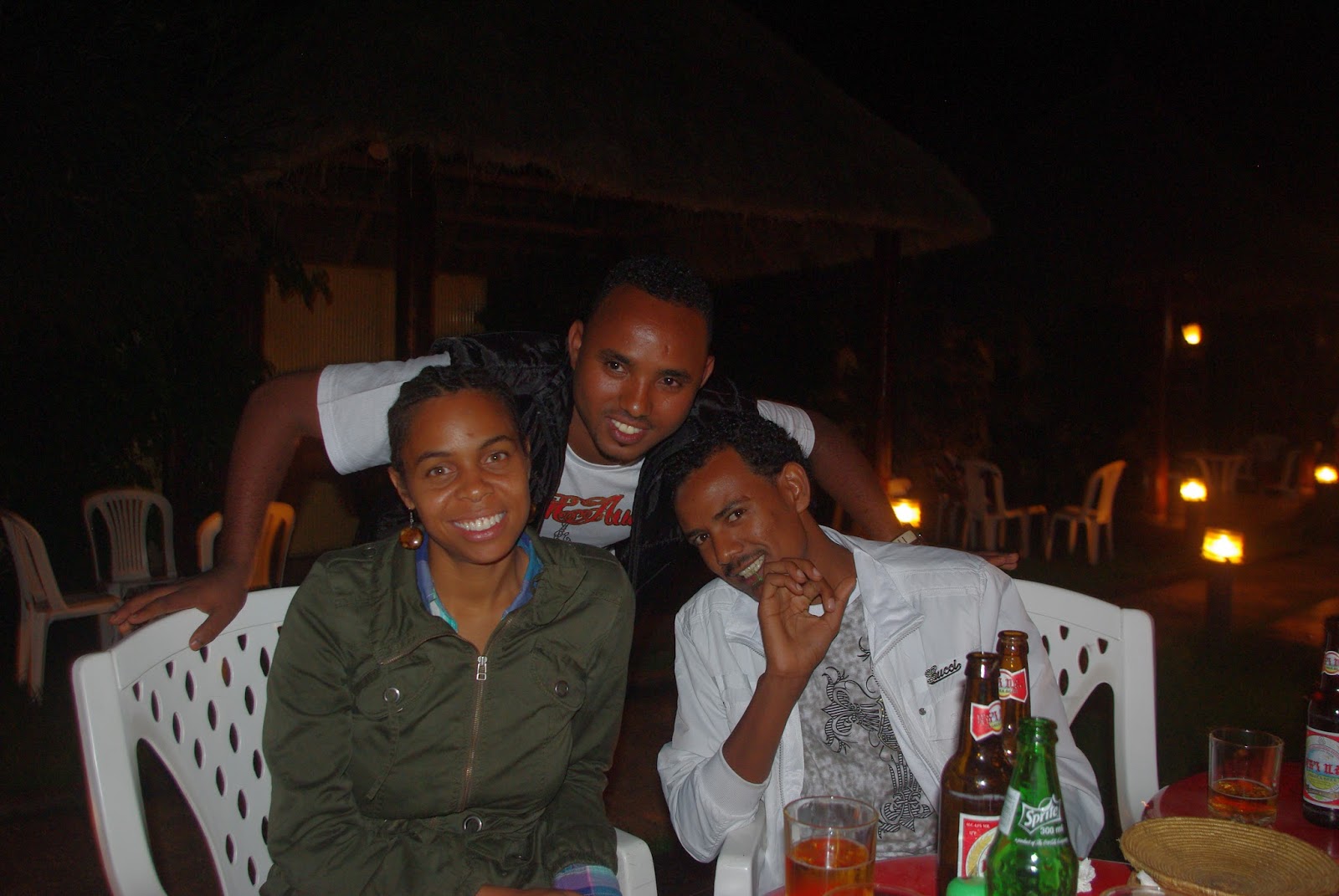
Part of the helpful crew from Bahir Dar
My bus finally arrived. After standing on the curb for what seemed like forever, I was tired and ready to go home. I boarded the bus, watched the small man from the window, assured myself he’d be fine.
But it was late and he was far from home. 

Its been late and I’ve been far from home. In those moments I am forever grateful for the people who recognize my carefully concealed terror. The old woman on a bus in Durban who fussed at the driver and demanded he take me directly to my hostel, the two young men in Bahir Dar who drove me to a less sketchy hotel, the nun in Flores who helped me figure out where I was going. I didn’t even have to ask, didn’t have to stand on a curb clutching my bags. 

I have basked in traveler’s grace.

I should have stayed. I should have walked that man on the curb to where he needed to be. I should have been his English translator; I didn’t know what language he spoke but I could have cared enough to figure out a way to translate his needs. People have done that for me. I should have paid it forward.
I think about that man often. I send good travel vibes into the ether and hope that they found him another one of our tribe who was not so selfish as to choose 20 extra minutes of sleep over helping someone lost in the transition that is travel. 

That man and he has become, for me, a reprimand, a reminder, a mantra for who I should be at all times, not simply when I’m well rested or flush with time.

Blog prompt courtesy of Daily Post: Sorry, I’m Busy.