Showing posts with label africa. Show all posts

Wednesday, January 30, 2019

Closer Inspection (archived)

Upon closer inspection I realize that Monrovia isn’t dirty. At least not in the way I had it etched in my mind. There is dirt. The rainy season is ending and dirt – the dried remnants of rivers of mud – lines the street and abuts curbs. But this morning, I noticed that people had swept, were sweeping, the previous days trash into little piles. The garbage was – well – tidy. Little mountains of plastic bags and orange shavings ushered neatly together; joined by other small piles.
The end result…streets that whisper order into the face of chaos. And Monrovia does have its share of chaos.
Taxis vie with UN and INGO trucks for space on the road, swerving to miss potholes and each other. People wander into the street in a game of crosswalk chicken. Pedestrians dare cars to hit them as they scurry- or amble depending on ability and inclination- across a four lane street that is transformed into 5 or 6 lanes as old and rusting vehicles bob and weave for space and distance.
On the sidewalks- between men holding up any number of once living objects: chickens, bush rat, shrimp the length of a bar of soap- people signal with their hands where they want to go…finger in the air or hand outstretched in a kind of chopping gesture. As taxis slow to let someone out, a crowd gathers at the door gently pushing for space. Four people shove into the back and the taxi winds its way toward town. Silly me, I thought it would take us where we requested; instead it dropped us in the general vicinity, more bus than taxi. No bother, the ocean is a great landmark.
Monrovia isn’t that different from other cities I’ve been in. it could be Kandy (Sri Lanka) only there are more blighted buildings and fewer green handrails here. It could be Maputo or Nairobi. But it isn’t.
And when the sun set and the stores closed for the night the city took on a completely different flavor. There are only a few street lights to cast yellowish-orange rings of focused light on patches of sidewalk that spill – barely- into the street. Where shops had shuttered and bolted their doors, market women, their wares balanced in big bags or colorful buckets on their heads, laid out piles of used underwear and shirts for sale. Popcorn, fish, and coconut vendors sat placidly waiting for hunger to strike. Street kids darted between cars.
Despite being various shades of brown, BushDiva and I stood out as foreign – me with my light skin and fast walk; her with her dreadlocks and socked feet in Tevas. We looked like an easy mark but posed more of a challenge as we changed course frequently, left side right side, road sidewalk.
Back toward the convent, the bustle of city nightlife mostly behind us, the darkness reached for us. Shadows from the brick wall enclosing the compound threw shadows carelessly across our path making the last block seem like the longest.  Finally we reached the gate where we greeted the guards posted just inside and made our way to our room thankful for a different perspective on the city and for the sanctuary of leaving it behind.
November 23, 2009

Tuesday, December 22, 2015

A hand on my knee

When he placed his hand firmly on my knee for the second time, after my skillful maneuvering to remove it only moments before, I had an inkling that things were not going to end well. The little boy that had been relegated to the flatbed portion of the truck despite plenty of room in the cabin was no longer a buffer and we…we were driving through the bush far off the clay-packed ruts that passed for a road. 

The driver stopped the truck, the suddenness of it jerking me forward in my seat, and told me he couldn’t take me the rest of the way. More angry than scared in that moment, with the thorny bushes poking through my skirt and the sun beating down on my head, I cursed him. I cursed him as I walked several kilometers to the school I was visiting nestled in the hill I’d been deposited on.

Earlier, when he had stopped to ask me if I needed a ride, he seemed vaguely familiar. He was someone from the expansive village that was to be my Peace Corps home for two years. That he recognized me immediately was no surprise, everyone knew me - not-quite-leghowa (white person/foreigner) but definitely not local- I was destined to be known and  to never know everyone. 

When he'd slowed down and pointed out the shops he owned in the village, smiled and acknowledged my host family, and then offered me a ride, I jumped at the chance to shorten my commute and get to know someone from my community better. The cutie in the front seat, staring in the curious way all of the children in the village stared at me, sealed the deal. 

Never mind in America I would never climb in a strange man’s car, small child present or not, in the village context it seemed reasonable. And so I tried to skootch the little one over only to hear him directed to the back of the truck. 

Now we were two. 

The story could have ended so much worse. Rather than walking through the bush with no trail to guide me and arriving late to the school, I could not have arrived at all. 

Rage welled up in me, not fear, although in the coming months the incident would feed my fear. 

Being female has always made me …aware. Wherever I am in the world I understand that there are certain vulnerabilities both real and perceived. I maneuver the world with this in mind; not necessarily at the forefront of my mind but definitely there.

In the early months of my time in South Africa, my vulnerabilities  almost drove me home. More than homesickness and limited resources (no electricity or running water) fear crept into my mind in tiny increments and then with blurring speed. 

Everything in South Africa was new to me. I was fascinated by the newness. Like a small child waving hello to everyone and everything, I wanted to experience my surroundings. Coupled with the fact that while I am a black woman, nothing about me announced me as anything but foreign. So I drew attention. Children stared, women asked if I was a missionary or a student (I always had a book with me), and men proposed. This was my reality on foot, on khumbis (minivan taxis), at the market,  at the local police station.

Even after the newness factor wore itself to normalcy for me, I was still an anomaly in the village, on local transpiration, wherever I went. Reading was often interrupted by questions. Where are you from? Why are you here? What religion are you? Are you married? People greeted me constantly- partly because greeting is a cultural norm and partly because everyone remembers the random leghowa in the village. Everyone remembers and so people were offended if I didn’t remember them form a khumbi ride 6 months ago in a different city. 

There were a lot of questions an comments bred from curiosity and then there was harassment.

Marriage proposals from complete strangers started off funny, I assumed they were excuses to speak to me. But sometimes they weren’t jokes and laughter or a “no thank you” inspired hostility and entitlement. My American-ness posed its own problems. The common assumption about American women is that we are promiscuous. Coupled with the absence of family, I was untethered. I was a sexual object outside the accepted cultural norms of behavior. 

The absence of tethering made it possible for the police at my local police station, to feel me up when I arrived to introduce myself as a safety measure- the irony was not lost on me. That interaction with the police prevented me from calling for help when a khumbi driver in Louis Trichardt felt me up, running his hands from my torso beside my breasts and down to my legs. Those things are what stopped me from doing anything but freezing up inside when a man I met at the Reed Dance Ceremony in Swaziland extended a handshake too long and circled his finger in my palm, refusing to release it, in a common if adolescent request for sex.

Getting banished from the truck in the middle of the bush happened before I experienced most of those other things; back when everything, including harassment, was still new to me. So it didn’t scare me, not the way it scared the teachers at my school I was going to visit. Of course they were scared for different reasons. They were fearful for the American in me. Fearful that I would lose my way or stumble and fall in the bush. Fearful that my delicate Western ways would falter under African conditions. No one mentioned a man’s hand on my knee and neither did I.

About six months into my life in South Africa, with almost two more years before me, I contemplated coming home. 

Sitting on the khumbi in Petersburg, waiting for it to fill and begin the journey back to my village, a man sat beside me and attempted to strike up conversation. I kept my head bowed, pretended to read, pretended to be deaf and unable to feel his hand tapping me lightly on the shoulder. Two hours later, on the last leg of my journey home I relaxed a little. And in relaxing, I realized that same man was on this khumbi. Realized he was someone from my village. Realized he had only been trying to say hello and I had treated him like a ghost – invisible and unwanted. 

Fear had driven me so far from myself, so far from the reason I travel. How could I experience a country if I couldn’t or wouldn’t experience the people? And of course, how do you experience people if you are too wrapped up in fear?

With time I figured out how to navigate my fear. Figured out how to tether myself to my host-family, how to use humor as deflection, how to weave myself into cultural norms instead of floating outside of them. I made friends. I asked questions. I trusted my gut. With time the fear receded into memories, but not the strongest memories of my time in South Africa. Not stronger than Hunadi giving me a bowl filled with homemade biltong when she learned I didn't have any meat at my house, or Naniki sliding through the fence to discuss books, or Mr. Mokopo making me dinner. Not more than my host-mother sticking her finger in my hand-whipped lemon meringue pie to assure me it wasn't cooked yet (it was), or Magajedi laughing at me as I stood on a chair crying about the rat she'd purposely trapped in the kitchen with us.

Fear, like that man’s hand on my knee, was pushed aside and I was left to chart my own path forward.
DailyPost prompt: Safety First

Monday, December 7, 2015

I left him stranded there...

He looked lost and a little afraid. His eyes darted back and forth and he was pushing an airport cart heavy with luggage that telegraphed a long journey. I remember thinking how awful it was to land in America, not even able to access American currency, and being charged for the cart to haul your luggage.

He was small. 

Standing outside of DFW, cars and buses flitting to a curb and then away in ever thinning clusters.

I recognized his expression. I’ve worn that look a couple dozen time at an airport, any airport, in a new country. Knowing I stand out, knowing I don’t know what I don’t know. It is always the most exposed and vulnerable I feel in a new country. In Sri Lanka that look led to a $40 taxi fare instead of a $2 one. In Peru it led to an hour walking through town with my luggage until finally agreeing to pay for a taxi. In Ethiopia it felt dangerous, a late flight and a poorly lit parking lot and me with no convincing language skills to speak of.

This man was of my nomadic tribe. I recognized myself in him. 

I also recognized fatigue. In me. I’d been traveling. I don’t know where I’d been or how long. I think my flight had been delayed or maybe I’d had to check luggage and they’d misplaced it. I don’t remember the particulars, only that I was tired. I averted my gaze and searched through the glaring orange lights and receding darkness for my shuttle bus.

I stood on the curb too, a little bit away from this man. This man with all of his belongings in a cart by his side. I watched him look at the same signs repeatedly hoping, I imagine, that they might make more sense each time he looked. Disheartened that they didn’t. 

He scanned the few faces on the curb looking…looking for me I imagine. Not the actual me but the me that recognized myself in him, the me that understood his trepidation and could help. Our eyes finally met and I stopped searching the bus lane for my bus. At least for a moment he had my attention.

The details are fuzzy now, only my guilt is crisp and clear.

He was confused about where he should go. I remember pointing to the sign, repeating the information, having him repeat the information. I think I made a phone call on the airport information phone. I nodded encouragingly as I gave him information, hoping he’d nod comprehension back, and he nodded. I’m certain his nodding mirrored my nodding, wasn’t an indication of clarity. But he nodded, I told myself.

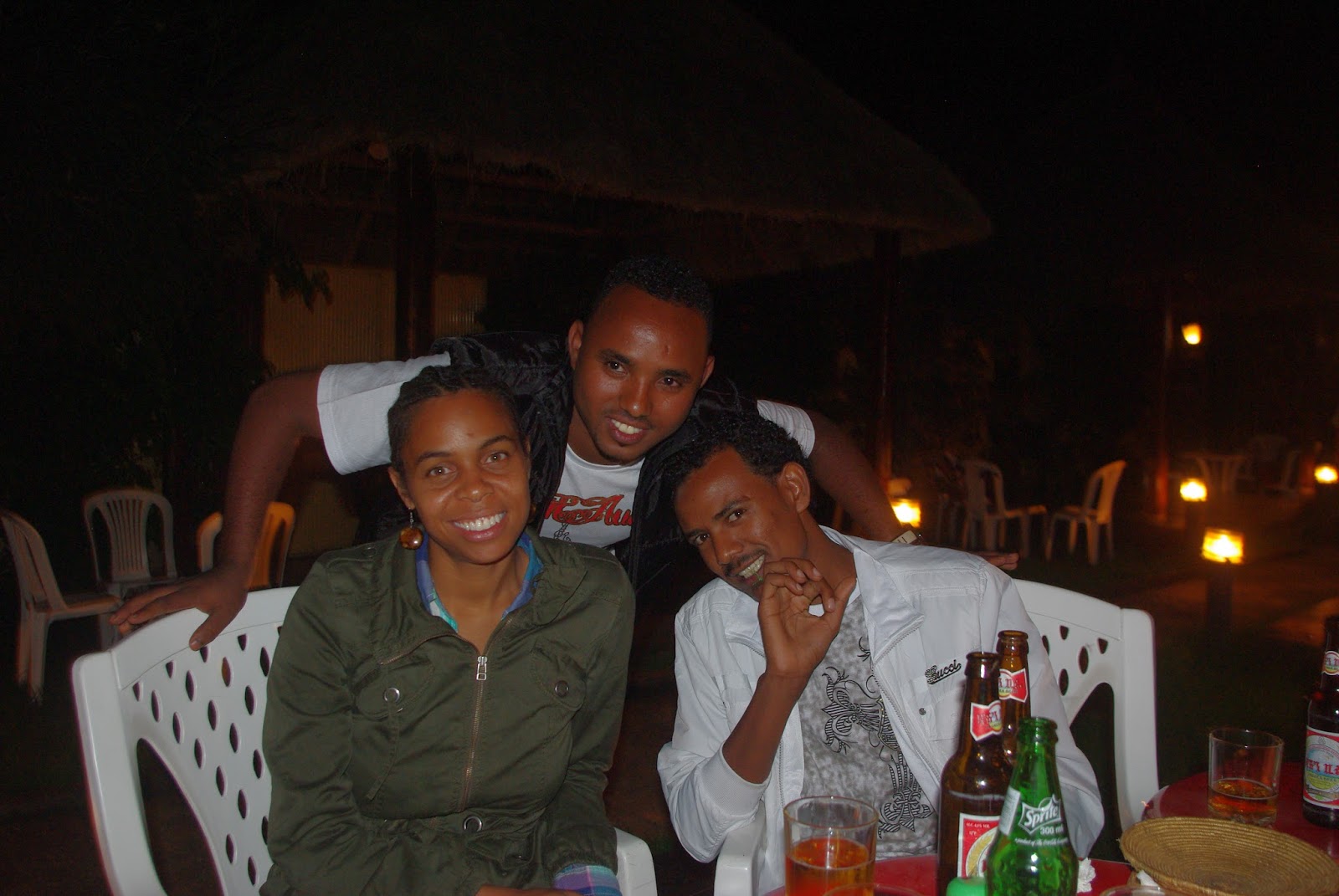
Part of the helpful crew from Bahir Dar
My bus finally arrived. After standing on the curb for what seemed like forever, I was tired and ready to go home. I boarded the bus, watched the small man from the window, assured myself he’d be fine.
But it was late and he was far from home. 

Its been late and I’ve been far from home. In those moments I am forever grateful for the people who recognize my carefully concealed terror. The old woman on a bus in Durban who fussed at the driver and demanded he take me directly to my hostel, the two young men in Bahir Dar who drove me to a less sketchy hotel, the nun in Flores who helped me figure out where I was going. I didn’t even have to ask, didn’t have to stand on a curb clutching my bags. 

I have basked in traveler’s grace.

I should have stayed. I should have walked that man on the curb to where he needed to be. I should have been his English translator; I didn’t know what language he spoke but I could have cared enough to figure out a way to translate his needs. People have done that for me. I should have paid it forward.
I think about that man often. I send good travel vibes into the ether and hope that they found him another one of our tribe who was not so selfish as to choose 20 extra minutes of sleep over helping someone lost in the transition that is travel. 

That man and he has become, for me, a reprimand, a reminder, a mantra for who I should be at all times, not simply when I’m well rested or flush with time.

Blog prompt courtesy of Daily Post: Sorry, I’m Busy.

Tuesday, July 7, 2015

Sparklebright


She had the brightest smile. Bright like whites in the summer sun. Bright like kittens purring against your hand. Bright like nothing bad had ever happened. 

It has been so many years I can’t tell you how we started talking, or what mental or physical state I was in when we did. It was after my accident. My head was bandaged but I don’t know how far into the AZT I was. I don’t remember how sick I might have been. Only that when I remember it now, through the gauzy haze of nostalgia and toppled into the memory pit of a time, I can see her smiling as bright as anything, laughing as lightly as dandelion fluff. 

My trauma was obvious. Written all over my face with bandages, spiky stitches, and the constant nausea for my post exposure prophylaxis (a precaution against the unknown origin of the hospital needles). And if it were later, and the stitches were already gone, then my trauma was still obvious, with a raw jagged line running through a patch of shaved scalp. 

Her ailment was her secret to tell. 

We sat on a bench I think, waiting for appointments? Lingering after appointments? Sharing the same bed and breakfast? I can’t recall details; only that we talked and shared and laughed.

I have a memory of her joyful description of her house in Malawi. Her washing clothes in the doorway. Even talking about the mundane chores of rural Peace Corps life seemed pleasant with her, not in the obnoxious way where you want to shove a sponge in someone’s face, but in the…hmmm, I should try it her way, kind of way.

We talked about her travels. About making friends and keeping in touch. We talked about the difficulties of having no shared language. This was before google translate or babblefish. This was us sitting in a country whose internet, I was sure, was run by a lone hamster dying of thirst on a rusted out wheel.

I don’t remember exchanging addresses. How could I remember that when I can’t remember where she fits between the first time I threw up (from the smell of dinner -it didn’t matter that I was starving -my body heaved in revolt and I remained famished) and lying on the floor of my assistant Peace Corps Director’s office, under the air conditioning for 8 hours at a stretch for the sake of cooling my nausea. She is in there somewhere- a shining beacon, a moment when maybe I wasn’t fixated on sickness or pain.

I returned to my village a moth after my accident. Thinner. Weaker. Skittish of loud noises and sudden stops. I made my rounds in my village. Reacquainted people with me, attempted to find my place in the now strangely foreign place that until weeks before, had been my home. 

Sometime later – in my head it is February but that isn’t right because I’d been home barely a week by that point- I got a package in the mail. Inside were bath salts “for my bucket bath” …sweet smelling reminders of home. Beneath those envelopes wrapped in plastic bags, was a bag of marshmallows. 

Sitting in the Peace Corps doctor’s office, comparing Malawi to South Africa, sharing the yearnings of youngish people so far from home tangled in with adventures and lamentations…she remembered. She remembered what I said I longed for so far away from familiarity and the comforts of home. 

Through the mail, across the miles, her so removed from the sub-Saharan life we had discussed and shared…she remembered me. She remembered me and mailed me a piece of home.

Fifteen years later, the thought of her still makes me attempt a smile as bright as hers.