Wednesday, April 23, 2014

Leaning in...

“What do you mean there is no male privilege?”

I was doing my best to keep my voice even, to sound matter of fact – as if I were simply inquiring about the weather or his disinterest in a television show I follow. “Seriously, you don’t watch Grey’s Anatomy?” followed by a raised eyebrow and then a silly quip. 

This wasn’t about television though, this was about privilege.

“What about racism?” I asked. Reynard is a 6ft 2in black man with milk chocolate skin and eyes to match- but if he subscribed to a so-called colorblind world than I knew it was a futile argument. “Of course there is racism” he replied with a hint of “duh” in his voice. 

At least we had some common ground so I waded around in that world for a little bit. We talked about the subtle ways blackness is marked as other or different or inferior. We talk so well, we’re not like others, clutching of purses, assumptions about our rearing. The usual.

Then I took a right turn at religion. 

The religious card is easy enough for me because it isn’t something I’m vested in. One of the reasons I find it difficult to be religious is the seemingly arbitrary rules. 

“What about man as the head of the house?” I asked. “That is inherently placing a man in a superior position.”

“Not really,” he responded vaguely. Then he talked for a while in circles that reiterated that it was ok for the head of a household to be dictated by danglies but also denied that was somehow a privilege of said danglies. 

I was exasperated and, after talking myself in circles, I slunk into my seat and continued our drive in silence. 

I can’t pass judgment on Reynard even if I want to, I fear that right now I am him on trans issues.
I am ignorant. 

I had never heard or thought of trans issues (other than as punchlines that are so common on television and in movies) prior to moving to California. I was part of the mainstream and didn’t “have” to learn. But California life happened and several things converged and brought it to my attention.
·         I said something stupid to a friend and she rightly corrected me
·         I became acquainted with a trans man
·         I saw W. Kamau Bell’s set on trans issues
·         I saw Janet Mock on Colbert
Clearly exposure is key.

W. Kamau Bell talked about leaning into difficult conversations – be they racism, sexism, homophobia, or …I’m not even sure what it is to be transphobic…I guess that is the term.
Somewhere along that time Janet Mock came into my sphere of knowing and so I vowed to read her book, Redefining Realness. I want to understand. The very least I can strive for is to not be an asshole and at my best I could be an ally.

And so I’ve been trying to understand. Two-thirds into Redefining Realness I don’t feel myself understanding any better. In fact, I find myself aggravated at what feels like reinforcement of gender norms – girls should be dainty and delicate and sassy and well put together, boys should be butch and like sports and hang out with men. I want to scream…but this isn’t about my issues with gender norms, this is about my quest to understand trans issues without assuming it is a trans person’s responsibility to explain to me. 

I don’t feel substantially further along than I was when I started; I’ve gained no new insight.
I honored self-selected pronouns before reading the book. I respected choice before. 

A co-worker described it as not feeling as if you were born into the right body. And when she is talking to me it makes perfect sense and I nod my head. And then a few hours later I find myself grasping for that understanding. And it is gone. 

It is easy for me not to grasp- for whatever issues I have about how people view my version of womanhood, I feel like I fit in my body, I am cisgendered. If I understand nothing else, I know that is a luxury not everyone has.

I can easily be Reynard. I can be righteously indignant at the Supreme Court for not recognizing race privilege, Reynard for not recognizing gender privildge, and at the same time be blind to my own privildge. Privildge of citizenship, and primary language, and my body reflecting who I feel I am in it. 

In my quest to understand…and it continues…I realize that it doesn’t actually matter if I understand; trans issues don’t cease to exist or cease to be important just because I haven’t managed to grasp them yet. In the meantime, I’ll keep reading.

Thursday, April 17, 2014

Silken Road


Bear nuzzled up to my hand, a puppy face although probably an older dog. He’d growled through the gated door, the shade and light conspiring together to prevent me from seeing him- only allowing the sound to take me back to the German Shepard that terrorized me at work for two years...but I digress.

Once bear sniffed me he padded softly beside me, through the house and into the backyard. The late afternoon sun was pushing the house’s shade over the patio so we pulled chairs into the waning swath of sun and waited for Silk to join us.

She sat down, clad exclusively in white with silver cowrie shells dangling from her ears. She smiled warmly and I settled in to my seat unsure of the reason for our visit.


RhythmQuest (RQ) was intent on pulling me out of myself. Insistent that my view of her was expansive and my view of myself shadowed and stunted. It was a random assertion that sprang from a passing comment I'd made in the car.

On the way to Silk’s I'd said, "I'm a good writer, I just have no story to tell." It seemed harmless to me. It felt an honest assessment of both my strengths and my weaknesses. I started off as a journalist - by definition someone who tells other people's stories. It wasn't meant to disparage myself or my talents but RQ was on me immediately.

"What do you mean you don't have stories? The problem is you don't see your own talent - your own worth."

How did we get there?

“It isn’t that I don’t think I’m worthy...” RQ sighed and rolled her eyes as much as is possible while driving without careening us into an oncoming car. I tried again, “It’s just that your personality is expansive,” I faltered for a moment. “Things happen to me but you seem to seek them out...” It still wasn't right. In my head it made sense but on my tongue I could understand her cynicism. Even so, it was such a strange conversation. Such a strange train of thought that was out of context and ill placed after such a wonderful weekend.

She listed off a litany of experiences, my experiences, that were not of chance. “Volutneering for FEMA after Katrina, escaping to Guatemala after Katrina because you were so upset, any of the countries you lived in.” I listened and tried to be open. I could hear where she was coming from but somehow it made sense when she said it but melts away when she is finished. What would I say about FEMA- about Guatemala? Who would read it? Why?

Sitting in Silk’s backyard, a small oasis of raised beds housing kale and tomatoes, and California-climate appropriate succulents, I assumed the matter was dropped. I don’t know Silk and besides, I assumed RhythmQuest - or Silk - had a reason for the visit. 

They fell into conversation; I skimmed its surface, listening in for pieces that I understood or had context for. RQ, began to expanded the short-hand they had been using to invite me into their conversation, swivelling her chair to make eye contact and providing me details that gave me details and understanding..

Suddenly, Silk, soft spoken and deliberate said...

I can't remember what she said. She repeated it no less than four times but by the second I knew that as far as RQ was concerned it was for me. Silk had leaned forward to impart these words of positivity and assurance to RQ. “Repeat that,” RQ said with a smug smile. “Say it again,” she said when Silk complied. This time she placed her hand on my knee and smiled giddily behind her large brown sunglasses. “I don’t need you to repeat it for me, it’s for her,” she laughed as I flipped her the bird.  

Such irony that despite her repetition I can't recall exactly what she said. Specificity of words aside, it left me with the sentiment that I am meant to unfurl myself to the world-meant to declare myself without reservation.


And then the afternoon shifted and suddenly the spotlight- and not just the sun- was shining on my world.

Silk asked for my story, in her soft and inviting voice. Before I could answer, RQ jumped in and filled in the big spaces the way I usually do with her. She rattled off a close proximity of the list she’d just enumerated in the car. I fought back an urge to cry although I have no idea why.

Silk gently asked me questions about what I do now and my travels and my writing. She shared her ideas about healing people and through that healing of individuals, healing groups. Healing us- black people- with our generations of scars and suffering.

And then she quietly wove in her own story, the journey she is on to manifest her own greatness and the long journey she is still on to get there.

I was caught up. Caught up in her calm and sincerity. Caught up in the credibility a stranger strangely possesses that loved ones cannot.

In some ways Silk is still tainted by love. She loves RQ and and RQ loves me and so who wants to sit in the energy of a friend and tell them the person they love is ordinary. But something about Silk fights against my cynicscm about the biases of love. Something about the quite yet powerful way she seems to inhabit the space around her left me slightly lit – a pilot light of possiblity in charting my own story in less ordinary ways.

Now it is necessary to ride Silk’s wave of certainty about my potential to do something...to do something. To do and not just say that I will do...one day.

I sat down this evening and wrote for more than an hour. It is a step. Not the only step by far but a step none the less.

Thursday, April 10, 2014

Not an African love letter


The boy who gave me my first kiss emerged from a seven-year absence mandated by his fiancé. Like any satisfyingly formulaic romantic comedy, he found my parents’ phone number (after his divorce) at the bottom of his dresser drawer in his childhood room at his parents’ house. Following a series of improbable coincidences and quirks of fate, he contacted me. More extraordinary and movie-like, he flew 2000 miles west for a visit.

His visit was a splendid suspension of reality, a novel romp through nostalgia dusted memories. I knew we were looking fondly at an aged and staged photograph with the bad- maybe not bad, simply the reality bits that intrude on fairy tales- cropped out. He didn’t seem to realize that. His conversations held tightly to “us” as fated. 

He spoke of an “us” that at its best was 10 years old and at its worst, 15. He spoke of a togetherness and marriage and babies. He spoke of second chances without ever wondering, let alone asking, what-if any- chances I wanted. 

“I don’t want babies,” I countered his assumption of our hypothetical life together. He seemed not to hear me. Truth was inconvenient to his daydreams of me at home with two or three kids. It was less about me and more about a narrative he was intent on playing out. He wouldn’t hear me. And although I trusted that he wanted to love me...he made it painfully obvious that he didn’t see me; wouldn’t learn me. How can you love what you don’t know?

In his world I was forever my 12-year-old self. Unchanged and uncomplicated.
Africa is loved in a similar way. People love Africa as a blank slate to project hopes and dreams- and sometimes nightmares- on.
 
People beatify the entire continent, paint it in benevolent victim-hood, fly Kente cloth flags, beat random rhythms on djembes and call it love. Africa – vast and diverse as it is- becomes faultless perfection. It is the 12-year-old girl frightened of her first kiss. It is teenage affection with no brokenhearted baggage. Africa is forced into a one-dimensional depiction of itself because anything more is complicated. 

At conferences and festivals targeting the American section of the African diaspora, people pour out libations to an ancestral abstraction or “ashe” every statement of the appointed elder of the group, and I feel a protective hostility. Maybe it is unfair but a small rage blazes in me and I sit mute to music, call and response and the other curated depictions of the “Africa experience”. 

It is shallow love. It is love at first sight before reality knocks and conversations about religion and money and careers and chores and snoring and every nit-picky thing that tests love every day.
This love of an “African ideal” is a summer fling, passionate and urgent with no time (or inclination) to love deeply-to learn. 


but you say i'm foolish
of course you love me
but being loved of course
is not the same as being loved because
or being loved despite
or being loved


I have a complicated relationship with Africa- at least with the 16 countries I’ve lived in or visited and a handful of others that are significant to me for one reason or another. The complexity of the continent and my experiences with/in/on prevent me from feeling comfortable with sweeping statements about my affection – or lack of it. Prevents me from “loving the culture (without an “s” on the end)”, deifying the people, “they are so noble and kind”.
Some people, some things, suck. Africa is not exempt.

To love is not to feign perfection, it is to understand that imperfections are a part of the deal.
I won’t write a love letter to Africa. Africa is too vast, too varied, too complex, to contradictory. Africa is both changed and constantly changing. To gloss over the crannies and nooks, to pretend there are only brave survivors and no crooks, is as limiting and simplistic as seeing only corruption and famine. Africa – continent, not country, may contradict itself; it is large, it contains multitudes.


Tuesday, April 8, 2014

Packing: better late than early


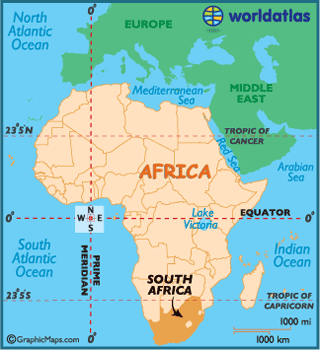
I packed weeks in advance. And by packed, I mean I had a heap of things I was certain I’d need during my two year stint in South Africa as a Peace Corps Volunteer. I remember getting the handbook in the mail and reading it feverishly – digesting every little morsel and trying to intuit whatever was unsaid. 

Would there be electricity? Would I have to haul water? Would people speak English? What language would I learn?

My mind spun with possibilities and uncertainties. But the certainty I had was the mounting pile on the living room floor. In retrospect, my parents were gracious. My mom didn’t nag me about it. She didn’t demand I move it to a less visible place- my room for instance. She let me place jeans and shirts, and books and journals and, my god, I don’t know what else, into that ever growing pile. 

Maybe a week before I was scheduled to leave I realized it was time to actually put things into the suitcase in preparation for my departure. I dissolved into a puddle of tears, unable to wrap my brain around the simple task before me. 

The only solution I could muster was an unintelligible and tear filled call to my then-best-friend. If she understood nothing else she understood the panic in my voice. 

I answered the door and then stood in front of mount-crap-I-don’t -need. She spent a moment taking it in and then reached for the suitcase and began to hold things up to me.

“Do you need this?” I’d answer with a feeble yes or uncertain no. Yeses were folded and put into the cavernous luggage and nos were placed in a much smaller pile just out of the way. I don’t know how long it took – forever, an instant- she zipped it up and then…magically floated back home (or more likely hugged me and then drove home).

I was packed.

Only I wasn’t. The night before my departure I weighed my bags. Whatever my limit was, I was so far beyond it that I had another bout of panic. Only this time, instead of calling for outside reinforcements I simply unzipped my suitcase and my dad’s Air Force duffle bag (in use for sentimental and no practical reasons) and began exiling contents to the now growing pile of discarded things. 

This time my bags were whittled to within a reasonable threshold of the allotted weight. Two major pieces of luggage and a carry-on bag. I thought I was traveling light.

I wasn’t. 

Now I travel light. 

My move to South Africa taught me three major lessons:
1)   If you can’t carry it comfortably you don’t need to take it

I     2) you forget it you can probably buy it and if you can’t you can probably do without
3   

3)Pack the night before

I’ll start with the first one:  If you can’t carry it comfortably you don’t need to take it. Two major pieces of luggage and a carry-on seem like a perfectly reasonable amount of luggage for a two-year trip. And truthfully, I wouldn’t begrudge someone that amount of luggage. But what I learned, sentimental duffle bag strap digging unsentimental cuts in my shoulder from the concentrated weight on the thin strap, was that it was heavy and awkward. Ditto for the wheeled suitcase that dug grooves into the red clay “roads” and caught on jagged rocks. Wheels weren’t practical for the kind of travel I was doing. Wheels in a village context were comical. What I needed was a good sized backpack with proper straps and no requirement of smooth surfaces to help me lug it about. 

Years later, when I moved to New Zealand for a year I remembered those lessons. I still had my wheeled suitcase, but in the well paved and sidewalked streets of Auckland that made sense. My second piece of luggage was a bright orange hiking backpack I purchased when leaving South Africa. It is still my primary piece of luggage 13 years later.

Lesson two: If you forget it you can probably buy it and if you can’t you can probably do without it. I packed a lot of things when heading to South Africa. My thinking was, “what if…” what if they didn’t have it? And so I tried to foresee every little thing I might possibly want or need. Not only is that exhausting, it is also impossible. Not only is it impossible, it also defeats, in some small way, the purpose of travel.

Sure people travel to see things. The Blue Nile Falls, Tikal, the pyramids, lions in the wild. People plan trips to cross things off of their bucket lists. But one of the reasons I travel is to experience something
different. That can be as simple as food but often includes transportation, communication, friendship. If I’ve packed my bag so full of stuff I already know there is little reason (or room) to experience new stuff.

As much as I love Sour Patch Kids (and adore the friends who sent me bags of them while I was gone) I fell in love with Jelly Babies in South Africa, and rotted my teeth with those while I lived there. I washed my clothes with Omo (which ate through my whites and the skin on my hands but wow my clothes were clean!), in Liberia I learned how to start a coal pot (environmentalists close your eyes- I knotted a polystyrene bag in several places to make a wick, piled the charcoal around it and lit the top) and made boot-leg Pad Thai with instant noodles, onions, egg, and peanut butter on the coal powered stove, and in Uganda learned to make a stovetop pineapple upside down cake that made me quite popular. Those are all things I associate exclusively, not with my time in America but, with specific times in specific countries. 

There is also just the practicality of what I actually need. My early letters home to my parents during that first trip, I mentioned things I didn’t have but “needed”. I talked about things like isopropyl alcohol and hydrogen peroxide. A few months into my stay things began to settle and began to learn my new home. Fast forward a year and my family came to visit and they came baring gifts…among them, things I lamented the absence of in my early weeks away but had long forgotten or replaced with the local equivalent – Dettol for instance. It was the sweetest of gestures from my family, but unnecessary once I began to make South Africa home.

Finally, I’ve learned: Pack the night before. My first grown-up international trip trained me and I haven’t managed to break the habit yet. It drives my mother crazy even all these years later. When she knows I have a trip planned she’ll begin asking me a week or two out, “have you packed yet?”. My answer is always the same, “When do I leave?”.

It isn’t that I don’t think about what I need to pack, or even that I don’t make a tiny pile off to the side somewhere of things that will probably make their way into my bag(s) (anything less than a year and the chances of me having more than one big bag and a daypack are slim…circa lesson one); but why would I do it early? What good does that do? As long as I have my ticket, my passport, and cash, any packing omissions can be rectified. And besides, it gives me something to focus on in the anticipatory moments before a trip. I’m sure there are reasonable reasons why I should pack in advance but that isn’t my way and in travel preparation I am apparently a creature of habit.

Fifteen years ago I left on my first major trip and these are the things I learned and I continue to follow these basic lessons wherever I go. 

A few years ago when I was moving to Uganda I was packing my bag in the wee hours of the morning. One of my nieces padded down the stairs heading for her parents’ room because she had a bad dream. I intercepted, opting to let them sleep while I soothed her. I was a few hours from my flight to Kampala and clothes were still strewn about the dining room but I took a moment to sit down with my niece on my lap and rock her gently back to sleep. A few hours later my brother-in-law snapped a picture to capture the moment of me fast asleep sitting upright with my niece across my lap.

I hadn’t finished packing before I dozed off. For my mom that was a lesson in why I should pack early, for myself it was simply affirmation I was doing things right, I made my flight fully(ish) packed and on time. I wouldn’t know how to do it any other way.